Golden wind, p.1
Golden Wind, page 1
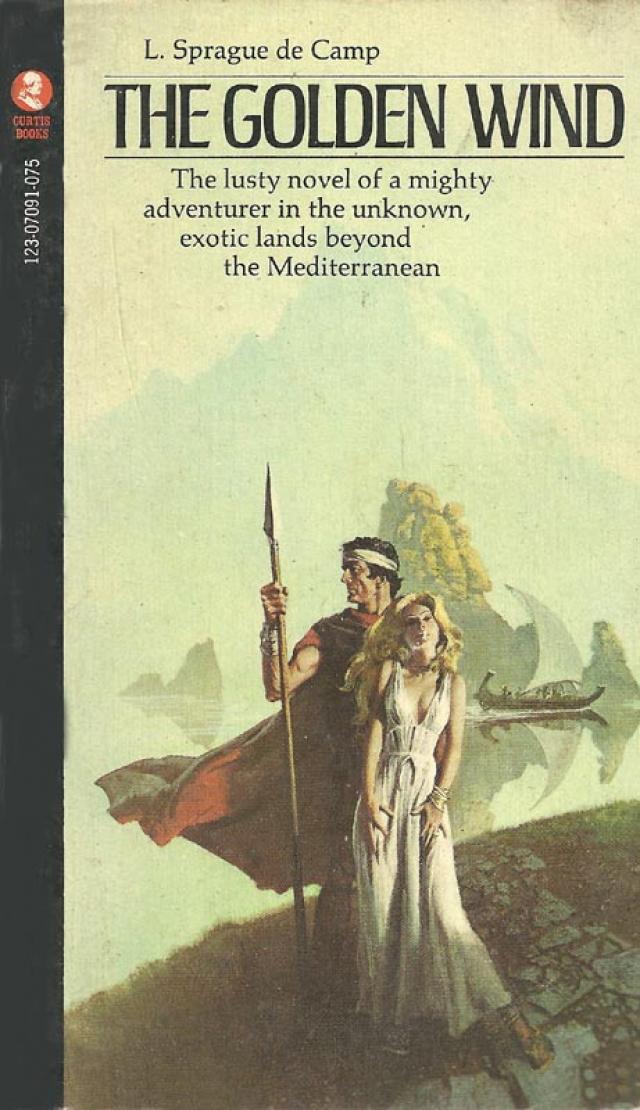


The Golden Wind
(1963)*
L. Sprague de Camp
Contents
EXPLANATORY LETTER
BOOK I — Hippalos the Corinthian
BOOK II — Agatharchides the Knidan
BOOK III — Rama the Indian
BOOK IV — Otaspes the Persian
BOOK V — Tymnes the Scythian
BOOK VI — Ananias the Judaean
BOOK VII — Eldagon the Gaditanian
BOOK VIII — Mandonius the Iberian
BOOK IX — Bocchus the Mauretanian
BOOK X — Nkoa the African
AUTHOR'S NOTE
Book Information
EXPLANATORY LETTER
Epistolê Exegetikê
Eudoxos son of Theon, of Kyzikos, wishes his son Theon well. The gods willing, this letter and the manuscript with it will reach you by a trustworthy captain of my host in Gades, Eldagon ben-Balatar the shipmaster.
You may have heard hard things about me from your mother's kinsmen. Before you do anything rash—like throwing away these papers unread—I pray you to hear my side of the tale. Although we have not seen each other in nearly a decade, I hope the love that is proper between father and son be not wholly quenched. Furthermore, aside from such considerations, I want you to perform certain tasks for me, and you will be more likely to do so if I justify my course.
Not to make two bites of a cherry, the principal task is to edit the inclosed manuscript, taking out parts that would discredit me or reveal things better kept quiet. In writing it, I have let myself go. But age is upon me, and my judgment as to what should be said may not be so keen as once it was. Then, arrange for publication, that the fame due my deeds shall not be lost in the river of time. There used to be at least two good bookmakers in Kyzikos.
The source of the trouble between your mother and me was, basically, the difference in our ages. If young men be any more wont to take their elders' advice than in my youth— which I doubt—you may profit from my example.
Now, in my own youth, I could pleasure women with the best of them. In fact, I was known to the whores, and hetairai of Kyzikos as a three-ball man. I speak in strict confidence of intimate family matters, and may a father's curse be upon you if you ever reveal what I am about to tell you.
I was well past forty when I began to tire of the sterile pursuit of pleasure women. My contemporaries were settled married men, some even grandfathers. To me, a peaceful domestic life took on a new attraction.
Discreet inquiries after a bride brought forth the daughter of my friend Zoilos the shipbuilder—your maternal grandfather. Your mother Astra was then twenty-two; she had been betrothed a few years before to a youth who had sickened and died.
At that time, my age—over twice your mother's—seemed a small matter. Moreover, at the start of our married life, I fell head-over-heels in love with her, like the hero of one of those sentimental novels that come out of Alexandria. I have never known a woman whom I desired so passionately, or whose company I so much enjoyed. I never expected to become an uxorious man, but there it is.
Nor did the feeling soon wane, as I have seen it do with other couples. I still feel that way about her, although she has been dead for years. While I do not really believe in the theologians' theories of a future life, the remote chance of being reunited with my darling Astra makes death seem almost attractive.
I am sure that your mother loved me, too, in spite of my broken nose and scars and pockmarks. When you were born, I thought my happiness complete. So, one would have said, what has Eudoxos to complain of? He is rich, respected, and famous, with a lovely girl for a wife and a lusty man-child. If he is no beauty, that does not matter, since he is not angling for lovers male, for whom he never cared. (My nickname as a boy was "ape," and a quarter-century of rough, adventurous life had done nought to better my looks.)
I need not tell you about the other sides of my career: the voyages I captained, the public offices I held, the missions and journeys I undertook for our city, the strokes of business that brought me the wealth you now enjoy, my adventures among the wild Scythians, and my scholarly researches in geography and exploration. All these things are well known in Kyzikos. But you must admit that, in my day, I was somebody. One would have said, some god must have cast his mantle over Eudoxos.
I fear, however, that the gods—if indeed there be gods— have an unpleasant sense of humor. Having been well taught by knowledgeable women, I introduced Astra with care to the arts of wedded love. Six years after our marriage, when you were three and I was just past fifty, she was as passionate a bedmate as one would wish.
But then, to my horror, I found my own lectual powers waning. My spear sagged like an overheated taper; my Egyptian obelisk began to turn from granite to putty at critical moments.
Slowly but inexorably this weakness grew. At first I thought little of it. Then, when I had to leave your mother unsatisfied several times in a row, I sought the help of physicians. Some said to drink more wine; some said to drink none at all. Some sold me powdered unicorn's horn and other rare medicines at fabulous prices. But nothing did any good. Once in a while I could still perform my husbandly duties; more often it was like trying to fight a battle with a length of rope for a spear.
Your mother became nervous and cranky, and I more and more frustrated. I loved her as much as ever. Moreover, I found that my decline as a lover was not matched by any wane in my interest in the act of love. I wanted her more than ever. My mind became preoccupied with memories of the last time we had enjoyed a good gallop and my hopes for the next one.
The most infuriating thing was that, in other respects, I was not prematurely aged. My hair was still black and thick, with only a little gray. I had all but two of my teeth. My belly bulged hardly at all, since I kept myself fit in the gymnasium. Few things so embitter a strong, vigorous, successful man as to find his masculinity failing him.
At last I poured out my distress to old Glaukos, the dean of Kyzikene physicians. He told me:
"Forsooth, best one, this weakness befalls most men sooner or later. In your case, the onset is a little earlier than usual, that is all. Some men are impotent all their lives; some become so in their thirties or forties. And, no matter what my colleagues say, no real cure is known. If you were a flabby, dissipated idler, I could tell you to drink less, keep regular hours, and get more exercise; but you already lead a healthy life."
Observing my hangdog expression, he continued: "Do not look so despondent, Eudoxos. A man feels about his loss of phallic vigor as a woman feels about the loss of her beauty. But these things overtake all of us if we are fortunate enough to live so long. The life of an oldster is still better than its only alternative—death."
"Then what shall I do?" I cried. "By the Heavenly Twins, Tin not old enough to submit tamely to this fate! I have been as happily married as a man can be, but this is no longer the case. Things go from bad to worse."
He shrugged. "When I studied in Alexandria, I met an Indian, who assured me that Indian medical science was far ahead of ours. He claimed that the wise men of India could prolong life, revive the dead, and do all kinds of wonderful things. If these tales be true, they could doubtless stiffen your yard for you."
"Ah, but are they truer
"Perhaps, perhaps not. I have never been to India and, save for this one man, I have never known anyone else who had, either."
"Nor I. It is said to be a fearful journey, the more so since the realm of the barbarous Parthians now lies athwart the land route to India."
"So they say," replied Glaukos, and we dropped the subject.
A few months later, Kyzikos made up an embassy to the court of King Ptolemaios Evergetes—Evergetes the Second, otherwise known—but not to his face—as ho Physkon, "the Sausage." Physkon staged a big spring festival in honor of Persephonê, and—she being our patron goddess—we sent a delegation of priests to take part in the rites and athletes to compete in the games. Since I had just finished my term as polemarch, and in view of my experience in such matters, I was appointed sacred ambassador and peace herald. I made the arrangements for the journey, governed the rest of the delegation, and represented the delegation in its dealings with the Egyptian court.
We traveled in the state galley. I took my slave, a Scythian named Gnouros. This was a quiet little man, who did as he was told and kept his thoughts—if any—to himself. This left Astra with only one servant in the house, our hired maid-of-all-work Dirka. But your mother preferred it that way. She felt secure, with daily visits to and from our many relatives, and she did not wish to have to break in a new slave or a hired servant in my absence.
As we headed out into the windy Propontis, I stood on the poop deck, waving to your mother, and she waved to me from the quay. I suppose you were too young at the time to remember that parting now. We waved until each was out of the other's sight. When Mount Dindymos sank below the blue curve of the Propontis, I wept tears as salty as the sea. Some of my fellow passengers spoke of this, and I made an excuse about the pain of leaving one's beloved city. It would not have done to admit that a mere woman had brought my feelings so visibly to the surface.
And so the tale of my later voyages, which has taken me months to dictate, begins. I hope you will find it beguiling for its own sake as well as an effective self-justification by your sire. Rejoice!
-
BOOK I — Hippalos the Corinthian
On the tenth of Mounychion, in the third year of the 165th Olympiad, [*Approx. April 1, 119 B.C. ] when Hippa
As we coasted the south shore of the Propontis in the state galley Persephonê, we had not gone three hundred furlongs [**1 furlong (stadion)= 1/8 mile.] before we passed the boundary of the Kyzikene lands and came abreast of those ruled by Rome. We made our overnight stops at those Ionian cities—Troy, Mytilenê, and Phokaia, for example—that the Romans had not yet raped of their independence.
Whilst our relations with Rome had been good, a small power like Kyzikos is well advised not to remind the Romans wantonly of its existence. The Romans are great ones for putting their noses into other people's business. It does not take much of a pretext—a tavern brawl between your sailors and theirs will do—to convince them that they owe it to the peace, of the world to take you under their fatherly wing. Then you awaken to find a Roman garrison in your city and a Roman proconsul stealing everything not firmly nailed down and selling you and your family into slavery in Italy.
So we avoided the Roman-ruled cities of Asia Minor. As it was, a Roman fiver came boiling out of the harbor of Ephesos as we passed, signaling us to stop. When the Roman galley drew close, an officer shouted across the water through a speaking trumpet, demanding to know who we were and what our business was. We told him and sailed on. Alas for the great days of Hellas, when the ships of a free Hellenic city went where they listed without anybody's leave!
Eighteen days after we set out, we raised the Egyptian coast near the Sebennytic Mouth of the Nile. I had been to Egypt twenty years before, as supercargo on one of the family's ships. The Egyptian shore showed the same dreary monotony: a land as flat as a marble flagstone in the temple of Persephone, rimmed by a never-ending beach, and beyond it a mass of reeds and a hedge of palms against the sky.
We sailed westward, past Kanopos and Boukiris and little fishing villages, until the coast rose in the slight ridge that passes for a hill in the Delta. And so we came at last to the walls of Alexandria.
At the Bull Channel, a pilot boat, with the red-lion pennant of the Ptolemies whipping from its masthead, led us into the Great Harbor. To our right, on the isle of Pharos, rose Sostratos' colossal, gleaming lighthouse, towering up at least four plethra, [* 1 plethron = 100 feet.] with a plume of smoke streaming from its top. On our left stood the fortifications and barracks at the end of Point Lochias, and then the temple of Isis.
Once we were through the channel, the Great Harbor opened out on all sides. On the right was the mole called the Seven Furlonger, joining the Pharos to the city, with scores of merchantmen tied up along it on both sides. Beyond lay the Old Harbor, or Haven of Happy Return, devoted to commercial and fishing craft. On the left, as we entered the Great Harbor, were the naval docks, with squadrons of Ptolemaic fivers and larger ships. Their hulls were black, and each bore a gilded statue of Alexander on its stern. Beyond and above the warships, the gilded roof tiles of the royal palaces glittered and their marble columns gleamed.
Near the palaces, a section of the harbor was marked off from the rest by a mole. In this inner harbor lay the king's private ships, which included three of the largest vessels in the world. These ships had all been acquired about a hundred years before, in the time of the fourth Ptolemy—Ptolemaios Philopator, the degenerate with whom the dynasty began to go to seed.
One of the ships was Philopator's pleasure barge. Another was a huge vessel built by Hieron of Syracuse. The tyrannos had meant to combine the virtues of a war galley, a merchantman, and a royal yacht in one hull; but the ship proved too slow for war, too costly for commerce, and too crowded for pleasure. So, in disgust, Hieron gave her to Philopator, who liked such nautical freaks.
The third ship was the largest war galley of all time, a for-tier over four plethra long. Four thousand rowers, pulling ten-man oars arranged in four banks, propelled her. She had proved too slow for any practical use, and the hire of so many rowers would have strained the finances even of Egypt; so she had been tied up and neglected. Of the three, the barge was the only one that had been kept up. The two galleys lay forlorn, with most of the paint gone from their woodwork and no oars in their ports. I suppose the kings now and then had their bilges pumped out, or they would have sunk from simple leakage.
The pilot boat led us to a wharf to the right of the naval docks, near the temple of Poseidon on the teeming waterfront. Here several other sacred municipal triremes were drawn up. I recognized the Athenian Salaminia, having seen her several times on voyages to Athens.
-
We had not finished tying up when a naval inspector in gleaming cuirass and a couple of Greek civilians came aboard. While the inspector went down the line asking every man on board his name and business, and the two customs men poked amongst our baggage, I saw a dozen people hurrying from the mass of palaces to our left, with cloaks flapping and helmet plumes nodding. The nearer they came, the faster they went. At last they broke into a run, the soldiers clattering and the civilians clutching their garments.
As they straggled to the base of the companionway, a furious argument broke out. Fists shook; insults were shouted. Presently two—an army officer whose harness flashed with golden trim, and a tall, red-haired civilian—attempted to ascend the plank at the same time. Since the plank was too narrow for this purpose, they tried to shoulder each other off. Then they fell to pushing and wrestling, shouting: "Out of my way, you collared knave!"
"You're mad, you temple-robbing sodomite!"
"Go to the crows, you thickskin, or I'll cut your lying throat!"
While they strove in this unseemly fashion, another man quietly climbed up on the plank and proceeded to the deck. He was about my age, lean and swarthy, with a shaven head, wearing a long white Egyptian robe and carrying an ornate walking stick. As he approached, panting from his recent run, the other two ceased their battle and followed him up the plank, still muttering threats and insults under their breath. The rest of the party followed.
Stepping down to the deck and speaking good Greek with a trace of Egyptian accent, the white-robed man began:
"Are you Eudoxos of Kyzikos, sir? The peace herald and sacred ambassador of Kyzikos? Rejoice! I, Noptes, high priest of Sarapis, welcome you in the name of His Majesty—"
At that instant the other two, also reaching the deck, burst out: "Rejoice, worthy Eudoxos! I welcome you in the name of Her Majesty—"
Then each of the three tried to shout down the others, so that I could hear nought but an unintelligible babble. At last I banged the deck with my stick and roared:
"By Bakchos' balls, shut up, you three!" Their voices fell off, since I was larger than any of them and far from handsome. "Now," said I quietly, "you got here first, sir priest, so finish your speech. You two shall have your chance later. Go on."
With a flicker of a smile, Noptes continued: "I welcome you in the name of His Majesty, King Ptolemaios the Benefactor. During the Persephoneia, you and your party shall be lodged in apartments in the royal palace. If you will follow me, sir—"
"Wait!" cried the other two together.
"All right," I said and indicated the officer. "You next."
"Sir!" The gleaming soldier brought his heels smartly together. He was a good-looking man in his thirties, with a close-cut black beard, and on his head a black-crested, bowl-shaped Macedonian helmet, with a narrow brim all the way round and cheek pieces of boiled leather tied together under his chin. In a guttural Judaean accent, he began: "I am Ananias of Askalon, deputy commander of the regiment of Her Majesty, Queen Kleopatra the Wife. In the name of Her Majesty, I welcome you and your party to Alexandria for the Persephoneia. You shall stay in the guest house of Her Majesty—"