The goblin tower, p.1
The Goblin Tower, page 1
part #2 of Novaria Series
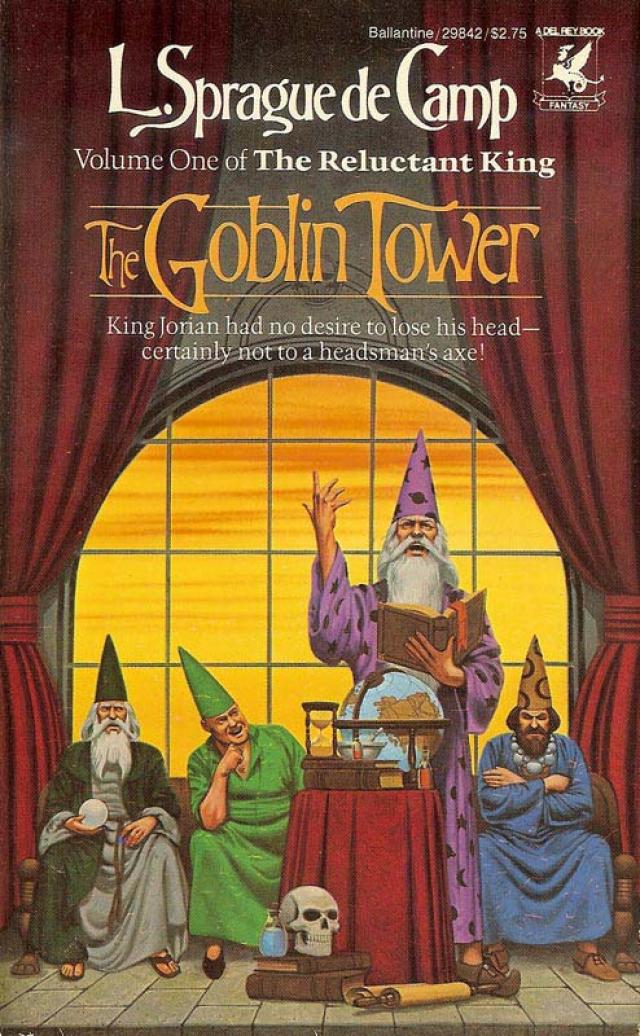


The Goblin Tower
Novaria 02
(1968)*
L. Sprague de Camp
Contents
Chapter One — A LENGTH OF ROPE
Chapter Two — THE GRAND BASTARD'S SWORD
Chapter Three — THE SILVER DRAGON
Chapter Four — THE CASTLE OF THE AX
Chapter Five — THE BUTTERFLY THRONE
Chapter Six — THE SERPENT PRINCESS
Chapter Seven — THE RUIN IN THE JUNGLE
Chapter Eight — THE SEA OF GRASS
Chapter Nine — THE SMARAGDINE GOD
Chapter Ten — THE FACELESS FIVE
Chapter Eleven — THE GOBLIN TOWER
Book Information
-
Chapter One — A LENGTH OF ROPE
"A CURIOUS CUSTOM," SAID THE BARBARIAN, "TO CUT OFF your king's head every five years. I wonder your throne finds any takers!"
On the scaffold, the headsman brushed a whetstone along the gleaming edge of his ax, dropped the stone into his pouch, squinted along the blade, and touched it here and there with his thumb. Those in the crowd below could not see his satisfied smile because of the black hood, which—save for the eye holes—covered his head. The ax was neither a woodcutter's tool nor a warrior's weapon. Whereas its helve, carven of good brown oak, was that of a normal ax, its blue steel head was un-wontedly broad, like a butcher's cleaver.
The scaffold rose in the midst of the drill ground, outside of the walls of Xylar City near the South Gate. Here, nearly all the folk of the city were gathered, as well as hundreds from outlying towns and villages. Around the base of the scaffold, a battalion of pikemen in black meshmail over scarlet coats was ranked four deep, to make sure that no unauthorized person reached the scaffold during the ceremony, and likewise that the victim did not escape. The two outer ranks faced outward and the two inner, inward.
Around the three sides of the scaffold, the notables of Xylar, in crimson and emerald and gold and white, sat on benches. Another rank of soldiers sundered the quality from the commonality. The latter, in brown and buff and black, stood in an expectant, amorphous mass, which filled the greater part of the field.
On the western side of the platform, this multitude surged against the inner ranks of soldiery. Here the throng consisted mainly of young men. Besides the hundreds of mechanics from the city and peasants from the farms, it included a sprinkling of the younger gentry. Hucksters wormed their way through this throng, selling cakes, sausages, fruits, sardines, wine, beer, cider, parasols, and good-luck charms. Outside the crowd of spectators, armored horsemen, with the scarlet hour-glass of Xylar on their white surcoats, patrolled the edge of the field.
Overhead, a white sun blazed in a cloudless sky. A puffy little wind ruffled the leaves of the oaks and poplars and gums that fenced the field. It fluttered the red-and-white pennants that streamed from the tops of the flagpoles at the corners of the scaffold. A few of the leaves of the gums had already turned from green to scarlet.
Seated among the notables, Chancellor Turonus answered the barbarian's question: "We have never had trouble in finding candidates, Prince Vilimir. Behold how they throng about the western side of the scaffold!"
"Will the head be thrown yonder?" asked Prince Vilimir around his forefinger, wherewith he was trying to pry loose a piece of roast from between his teeth. Although he was clean-shaven, Vilimir's long, light, gray-streaked hair, fur cap, fur jacket, and horsehide boots with the hair on gave him a shaggy look. His many massive ornaments of gold and silver tinkled when he moved. He had led the losing faction in an intertribal quarrel over who should be the next cham of the Gendings and hence was in exile. His rival, who was also his uncle, now ruled that fierce nomadic horde.
Turonus nodded. "Aye, and the catcher shall be our new king." He was stout and middle-aged, swathed in a voluminous azure cloak against the chill of the first cool day of autumn. "The Chief Justice will cast the thing yonder. It is a rule that the king must let his hair grow long, to give the judge something to grasp. Once a king had his whole head shaven the night before the ceremony, and the executioner had to pierce the ears for a cord. Most embarrassing."
"By Greipnek's beard, an ungrateful wight!" said Vilimir, a wolfish grin splitting his lean, scarred face. "As if a lustrum of royal luxe were not enough... Be that not King Jorian now?" The Shvenish prince spoke Novarian with fair fluency, but with a northern accent that made "Jorian" into "Zhorian."
"Aye," said the Chancellor, as a little procession marched slowly through the lane kept open by soldiers between the South Gate and the scaffold.
"He took me hunting last month," said Vilimir. "He struck me as a man of spirit—for a sessor, that is." He used a word peculiar to the nomads of Shven, meaning a non-nomad or sedentary person. Among nomads, the word was a term of contempt, but the Chancellor saw fit to ignore this. The exile continued: "I also found him a great talker—too much so for his own good, methinks, but amusing to listen to."
The Chancellor nodded absently, for the procession had now come close enough to recognize faces. First came the royal band, playing a dirge. Then paced the white-bearded Chief Justice of Xylar in a long, black robe, with a golden chain about his neck. Four halberdiers, in the midst of whom towered the king, followed. All those near the lane through which the party proceeded, and many in other parts of the field, sank to one knee as the king passed them.
King Jorian was a tall, powerful young man with a ruddy skin, deep-set black eyes, and coarse black hair that hung to his shoulders. His face, otherwise shaven, bore a fierce mustache that swept out like the horns of a buffalo. A prominent scar crossed his nose—which had a small kink in it—and continued diagonally down across his left cheek. He was stripped to his suppers and a pair of short, silken breeches, and his wrists were bound behind his back. A crown—a slender band of gold with a dozen short, blunt, erect spikes—was secured to his head by a chin strap.
Prince Vilimir murmured: "I have never seen a crown with a—how do you say it—a strap of the chin."
"It is needed, to keep crown and head together during the casting of the Lot of Imbal," explained Turonus. "Once, years ago, the crown came off as the head was thrown. One man caught the crown, another the head, and each claimed the throne. A sanguinary civil war ensued."
After the soldiers came a small, lean, dark-brown man in a coarse brown robe, with a bulbous white turban on his head. His long, silky, white hair and beard blew about. A rope was wound around his waist, and he bore a kind of satchel by a strap over his shoulder.
"The king's spiritual adviser," said Chancellor Turonus. "It seems hardly meet that the king of Xylar be sent off by a heathen from Mulvan, rather than by one of our own holy priests. But Jorian insisted, and it seemed but just to grant his last request."
"Who—how did the king come to know the fellow?" asked Vilimir.
Turonus shrugged. "For the past year, he has entertained all sorts of queer persons at the palace. This mountebank—your pardon, the Holy Father Karadur—drifted in, doubtless having fled in disgrace from his own land after having been caught in some vile goetic witchery."
Then came four beautiful young women, the king's wives. A fifth had given birth the day before and was judged not strong enough to attend the ceremony. The four present were gorgeous in silks and jewels and gold. After the wives came the shaven-headed, purple-robed high priest of Zevatas, the chief god of the Novarian pantheon; then a score of palace officials, and the ladies in waiting. Last of all came Kaeres the joiner, Xylar's leading director of funerals, and six cronies of the king carrying one of Kaeres' new coffins on their shoulders.
As the procession reached the foot of the scaffold, the band fell silent. After a low-voiced consultation, the Chief Justice mounted the steps of the scaffold, followed by two of the four halberdiers.
King Jorian kissed his four wives goodbye. They clung round his neck, weeping and covering his broad, heavy-featured face with kisses.
"Na, na," said Jorian in a heavy bass voice, with a rustic Kortolan accent. "Weep not, ma pretty lassies.
-
"The gods, who from their puerile pipes a billion bubbles blow,
Have blown us here. We waft and wobble, iridesce and glow,
Then burst; but from these pipes a billion bubbles more shall flow.
-
"Within the year, ye'll all have better husbands then I ever was to you."
"We do not wish other husbands! We love only you!" they wailed.
"But the weans needs must have stepfathers," he reminded them. "Now get 'along back to the palace, so as not to see your lord's blood flow. You, too, Estrildis."
"Nay!" cried the wife addressed—though pretty, the least beautiful of the four, stocky and blue-eyed. "I will watch you to the end!"
"You shall do as I say," said Jorian gently but firmly. "You shall go on your own feet, or I will have you carried. Which shall it be?"
The two soldiers who had remained on the ground laid gentle hands on the woman's arms, and she broke away to run, weeping, after the others. Jorian called: "Farewell!" and turned back to the scaffold.
As the king mounted the stairs, his gaze roved hither and yon. He smiled and nodded as his eye caught those of acquaintances in the crowd. To many, he seemed altogether too cheerful for a man about to lose his head.
As, with a steady step, Jorian reached the platform of the scaffold, the two halberdiers who had preceded him snapped to attention and brought their right fists up to their chests, over their hearts
On the far, western side of the platform, a few feet from the edge, rose the block, freshly carved and shining with new red paint. Between the flagpoles on the western side, a length of netting, a yard high, was stretched to make sure that the head should not roll off the platform.
Leaning on his ax, the headsman stood beside the block. Like Jorian, he was stripped to breeks and shoes. Although not so tall as the king, the executioner was longer of arm and even more massive of torso. Despite the hood, Jorian knew that his slayer was Uthar the butcher, who kept a stall near the South Gate. Since Xylar was too small and orderly a city-state to support a full-time executioner, it hired Uthar from time to time for the task. Jorian had personally consulted the man before approving the choice.
"The great trick, Sire," Uthar had said, "be to let the weight of the ax do the work. Press not; give your whole attention to guiding the blade in its fall. A green headsman thinks he needs must help the blade; so he presses, and the stroke goes awry. The blade be heavy enough to sever any man's neck—even so mighty a one as Your Majesty's—if suffered to fall at its natural speed. I promise Your Majesty shan't feel a thing. Your soul will find itself in its next incarnation before you wite what has happened."
Jorian now approached the headsman with a grin on his face. "Hail, Master Uthar!" he cried in a hearty voice. "A lovely day, is it not? By Astis' ivory teats, if one must have one's head cut off, I can imagine no fairer day whereon to have the deed performed."
Uthar dropped to one knee. "You—Your Majesty—'tis a fine day, surely—Your Majesty will forgive me for any pain or inconvenience I cause him in the discharge of my duties?"
"Think nothing of it, old man! We all have our duties, and we all come to our destined ends. My pardon is yours, so long as your edge be keen and your arm be true. You promised that I should not feel a thing, remember? I shouldn't like you to have to strike twice, like a new recruit hacking at a pell."
Jorian turned to the Chief Justice. "Most eminent Judge Grallon, are you ready with your speech? Take a hint and make it not too long. Long speeches bore the hearer, be the speaker never so eloquent."
The Chief Justice looked uncertainly at Jorian, who indicated by a jerk of his head that he was to proceed. The magistrate pulled a scroll from his girdle and unrolled it. Holding the stick of the scroll in one hand and a reading glass in the other, he began to read. The wind whipped the dangling end of the scroll this way and that, hindering his task. Nevertheless, being familiar with the contents, he droned on.
Justice Grallon began with a resum6 of Xylarian history. Imbal the lion god had established this polis many centuries before; he had also bestowed upon it its unique method of choosing a ruler. The magistrate spoke of famous kings of Xylar: of Pellitus the Wise, and Kadvan the Strong, and Rhuys the Ugly.
At last, Judge Grallon came down to the reign of Jorian. He praised Jorian's bravery. He narrated the battle of Dol, when Jorian had destroyed the horde of robbers that had infested the southern marches of the kingdom and had acquired the scar on his face.
"... and so," he concluded, "this glorious reign has now come to the end appointed for it by the gods. Today the crown of Xylar shall pass, by the Lot of Imbal, into those hands destined by the gods to receive it. And we have been a true and virtuous folk, these hands will be strong, just, and merciful; if not—not. The king will now receive his final consolation from his holy man."
-
Old Doctor Karadur had been unwrapping the rope from around his waist and coiling it in the center of the platform. From his satchel he produced a little folding brass stand, which he set down beside the rope. Out of the bag came a brazen dish, which he placed upon the stand. Out, too, came a compartmented pouch, whence he sprinkled various powders into the dish. He put away the pouch, took out flint and steel, and struck sparks into the dish.
There was a green flash and a puff of smoke, which the breeze whipped away. A many-hued little flame danced over the dish, sending up streamers of vapor. The high priest of Zevatas looked sourly on.
Karadur intoned a lengthy prayer of incantation—those listening could not tell which, since the holy man spoke Mulvani. On and on he went, until some of the spectators grew restless. True, they did not wish the ceremony over too soon, since it was the biggest event in then-calendar. On the other hand, when it came to hearing the unintelligible chant of a scrawny old fakir and watching him bow his forehead to the platform, a little went a long way.
Then Karadur rose and embraced Jorian, who towered over him. The fire in the brazen dish blazed up and sent out a cloud of smoke, which made those on the platform cough and wipe their eyes. Thus they failed to see Karadur, at the moment when his arms were around Jorian's huge torso, slip a small knife into the hands of the king, which were bound behind him. Karadur whispered:
"How is your courage, my son?"
"Oozing away with every heartbeat. In sooth, I'm frightened witless."
"Face it down, boy! In boldness lies your only safety."
Next, the band played a hymn to Zevatas. The high priest, a gaunt, imposing figure in his purple robe, led the throng in singing the hymn, beating time with his staff of office.
Then the priest bowed his head and prayed that the lot of Jorian's successor should fall upon one worthy of the office. He prayed to the gods to look with favor upon Xylar; he prayed that, in smiting sinners, they would take care not to harm the far more numerous virtuous citizens. His prayer was as long as Karadur's. The head of the cult of the king of the gods could not let a foreign wizard go him one better.
At last the high priest finished. The Chief Justice read a proclamation that whereas, in accordance with Xylar's ancient customs, Jorian's reign had now come to an end, he willingly offered his head as the means whereby the next king should be chosen. Judge Grallon finished with a sweeping gesture towards the block, indicating that Jorian should now lay his head upon it.
"Will Your Majesty have a blindfold?" he asked.
"Nay," said Jorian, stepping towards the block, "I will face this with my eyes open, as I did the foes of Xylar."
"One moment, your honor," said Karadur in his nasal Mulvanian accent. "I must—ah—it was agreed that I should cast a final spell, to speed King Jorian's soul to the afterworld, without danger of its being trapped in another incarnation in this one."
"Well, get on with it," said the Chief Justice.
Karadur brought a little brass bell out of his satchel. "When I sound this, smite!" He poured more powders into his dish, which flamed and bubbled.
"Kneel, my royal son," said Karadur. "Fear nought."
The crowd surged forward expectantly. Fathers hoisted small children to their shoulders.
Jorian cast a thoughtful look at the old Mulvani. Then he knelt before the block and bowed his head until his throat rested across the narrow, flat place on top. His chin lay comfortably in the hollow that had been cut in the west side of the block. His eyes, swiveling sideways, kept Uthar the butcher in the periphery of his vision. Uthar, bending over him, brushed Jorian's long, black hair forward to bare his nape.
Karadur uttered another incantation, gesturing with his skinny brown arms. This continued until Jorian's knees began to hurt from kneeling on the hard boards. Stepping back from the block, Uthar took a firm grip on the helve of the ax.