

Deep dream, p.1
Deep Dream, page 1


TWELVE TOMORROWS SERIES
In 2011, MIT Technology Review produced an anthology of science fiction short stories, TRSF. Over the next years, MIT Technology Review produced three more volumes, renamed Twelve Tomorrows. Since 2018, the MIT Press has published Twelve Tomorrows in partnership with MIT Technology Review.
TRSF, 2011
TR Twelve Tomorrows 2013, edited by Stephen Cass
TR Twelve Tomorrows 2014, edited by Bruce Sterling
TR Twelve Tomorrows 2016, edited by Bruce Sterling
Twelve Tomorrows, edited by Wade Roush, 2018
Entanglements: Tomorrow’s Lovers, Families, and Friends, edited by Sheila Williams, 2020
Make Shift: Dispatches from the Post-Pandemic Future, edited by Gideon Lichfield, 2021
Tomorrow’s Parties: Life in the Anthropocene, edited by Jonathan Strahan, 2022
Communications Breakdown: SF Stories about the Future of Connection, edited by Jonathan Strahan, 2023
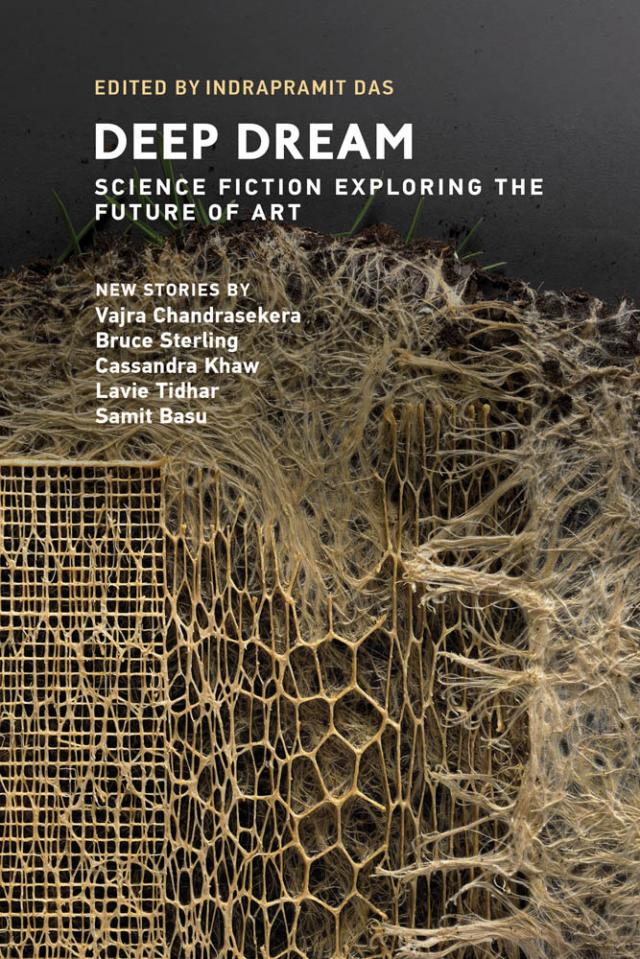
Deep Dream: Science Fiction Exploring the Future of Art, edited by Indrapramit Das, 2024
DEEP DREAM
SCIENCE FICTION EXPLORING THE FUTURE OF ART
EDITED BY INDRAPRAMIT DAS
THE MIT PRESS
CAMBRIDGE, MASSACHUSETTS
LONDON, ENGLAND
Compilation copyright © 2024 Massachusetts Institute of Technology
All rights reserved. No part of this book may be used to train artificial intelligence systems or reproduced in any form by any electronic or mechanical means (including photocopying, recording, or information storage and retrieval) without permission in writing from the publisher.
This is a work of fiction. Names, characters, places, and incidents are either products of the author’s imagination or, if real, are used fictitiously.
Selection and “Introduction” by Indrapramit Das. Copyright © 2024 by Indrapramit Das
“The Limner Wrings His Hands” by Vajra Chandrasekera. © 2024 Vajra Chandrasekera
“The Art Crowd” by Samit Basu. © 2024 Samit Basu
“Immortal Is the Heart” by Cassandra Khaw. © 2024 Cassandra Khaw
“Unauthorized (Or, the Liberated Collectors Commune)” by Ganzeer. © 2024 Ganzeer
“Halfway to Hope” by Lavanya Lakshminarayan. © 2024 Lavanya Lakshminarayan
“AI Concerns Are Not ‘Too Sci-Fi” by Archita Mittra. © 2024 Archita Mittra
“No Future but Infinity Itself” by Sloane Leong. © 2024 Sloane Leong
“Immortal Beauty” by Bruce Sterling. © 2024 Bruce Sterling
“Autumn’s Red Bird” by Aliette de Bodard. © 2024 Aliette de Bodard
“Encore” by Wole Talabi. © 2024 Wole Talabi
“The Quietude” by Lavie Tidhar. © 2024 Lavie Tidhar
Interior artwork by Diana Scherer. © Diana Scherer
Library of Congress Cataloging-in-Publication Data
Names: Das, Indra, editor.
Title: Deep dream / edited by Indrapramit Das.
Description: Cambridge, Massachusetts : The MIT Press, 2024. | Series: Twelve tomorrows
Identifiers: LCCN 2023053181 (print) | LCCN 2023053182 (ebook) | ISBN 9780262549080 (paperback) | ISBN 9780262379939 (epub) | ISBN 9780262379922 (pdf)
Subjects: LCSH: Science fiction. | LCGFT: Science fiction. | Short stories.
Classification: LCC PN6071.S33 D44 2024 (print) | LCC PN6071.S33 (ebook) | DDC 808.83/8762—dc23/eng/20240212
LC record available at https://lccn.loc.gov/2023053181
LC ebook record available at https://lccn.loc.gov/2023053182
d_r0
CONTENTS
INTRODUCTION
Indrapramit Das
1 THE LIMNER WRINGS HIS HANDS
Vajra Chandrasekera
2 THE ART CROWD
Samit Basu
3 IMMORTAL IS THE HEART
Cassandra Khaw
4 UNAUTHORIZED (OR, THE LIBERATED COLLECTORS COMMUNE)
Ganzeer
5 HALFWAY TO HOPE
Lavanya Lakshminarayan
6 AI CONCERNS ARE NOT “TOO SCI-FI”
Neil Clarke interviewed by Archita Mittra
7 NO FUTURE BUT INFINITY ITSELF
Sloane Leong
8 IMMORTAL BEAUTY
Bruce Sterling
9 AUTUMN’S RED BIRD
Aliette de Bodard
10 ENCORE
Wole Talabi
11 THE QUIETUDE
Lavie Tidhar
ARTWORK: DIANA SCHERER
ACKNOWLEDGMENTS
CONTRIBUTORS
INTRODUCTION
Indrapramit Das
In a tumultuous era of catastrophic global ecological and social crises, art may seem a frivolous human endeavor, useless in the face of coming struggles. But this isn’t a new idea, nor is art a young by-product of humanity; it has seen and, in its own way, recorded the ugliness and beauty of millennia worth of human existence. After all, who can imagine the human world, with its inevitable challenges and pains, without the collective dream of art to help us endure it? Art may not fix the present or the future, but it helps us deal with the former and allows us to imagine that we could still have the latter. It helps, to both positive and negative affect, bring an atomized species together in flashes of inspiration, to help us understand each other and experience human life communally across vast regions of space and time.
Art has changed as humans have changed, a testament to our capacity for endless invention: from cave paintings on rock walls finger-brushed out of crushed berries and animated by the flicker of fires, to the mechanistic wonder of the printing press, to the astonishing audiovisual replication of reality into our own aesthetic remixes via recording devices, to nonsentient algorithmic AIs “dreaming” imitative pastiche out of the old art of their human creators, to entire virtual worlds sculpted with the aid of computers.
In the year 2023, this changing landscape has begun to feel increasingly hostile. In its third year, the global COVID-19 pandemic has weakened in lethality and severity, but it continues to leave its mark on the world, with creative industries reeling from the disruption left in its wake and millions still affected by the disease. Fascist movements around the world have thrived, targeting artists in their escalating culture war, turning mainstream pop culture into a battlefield wherein bigots viciously attack books, TV shows, movies, comics, and workers in these fields for being woke, an AAVE term appropriated to now mean “offensive to bigots.” Governments around the world have too often responded in turn to this populism by embracing it, often institutionalizing these attacks—such as in the waves of book banning by conservatives in the United States or the censorious stranglehold on art that criticizes the Hindu nationalist government in India (or in parallel, the increasing use of Indian cinema to produce state-sanctioned propaganda films that mainstream stochastic terrorism against persecuted populations).
In this vulnerable moment, the corporate capture of mainstream, globalized art is coming into sharp relief. The culmination of media conglomerates absorbing multiple studios and publishers and consolidating massive monopolies has led to the already precarious value of artistic labor falling further. Blockbuster films with international audiences depend on CGI visual effects to paint impossible canvases of colliding dimensions and battling superheroes, gods, and monsters (all IP branded), but studios refuse to fairly compensate the artists, crew, and armies of technicians around the world responsible for producing them under brutal schedules. Entire movies and TV shows are being disappeared by these same conglomerates, banished to a state of artistic purgatory with no physical or digital release, so that the companies that own them can get tax write-offs and avoid paying residuals to artists. Streaming video has nearly broken both the broadcast television and theatrical film models, while slowly revealing itself to be a financially unsustainable model in isolation: a short-sighted, tech-influenced push to draw investment, recalling online media’s famously disastrous pivot to video or the Meta corporation’s failed attempt to create its hyped virtual metaverse. It’s no surprise that this year has seen strikes in industries across the world—including by the Writers Guild of America and the Screen Actors Guild, in response to the fraying labor rights of workers in Hollywood.
We’ve also seen generative AIs, or large language models (LLMs), leap into public visibility as potential competition for human artists across all media, despite the misnomer of “artificial intelligence” affixed to them (these models are not sentient like the AIs of science fiction, but rather programs that use applied statistics, as science fiction luminary Ted Chiang recently put it). That these generative AIs are using the uncompensated labor of thousands of artists as scraped data to produce their (human-prompted) “art” makes them seem less an evolution of art forms and more a potential labor-breaking technology for corporate use to many in the creative arts and media industries, who are already losing work to this new digital competitor. Pair this with the fact that running LLMs uses up vast quantities of energy and water during a mounting climate crisis caused by our global capitalist society’s dependence on fossil fuels and endless, unsustainable industrial growth, and there’s little reason to hype these “artistic” AIs as the first step to human transcendence promised by billionaires. In fact, generative AIs have done more to contribute to internet spam than art in the past couple of years. A deluge of AI- generated books has flooded Amazon, lowering the visibility of human writers and visual artists, alongside a similar tide of unpublishable generated short stories that have clogged the submissions queues of reputed science fiction and fantasy publications like Clarkesworld magazine, which had to shutter its submissions from human writers and artists temporarily as a result. Neil Clarke, the publisher and editor-in-chief of Clarkesworld, was able to elaborate on this uniquely contemporary problem and offer his thoughts on the current climate of the arts in an interview with Archita Mittra in chapter 6.
If there is optimism to be found in the advent of generative AIs and corporate destruction of arts industries, it’s in the hope that they will spur artists and their audiences and patrons to value their labor and organize to protect their rights in a world that lives off art (one need only look to the monetary value of the entertainment industry to confirm this, or how millions turned to art for sustenance when the pandemic locked us all down) but disrespects artists. Perhaps this will awaken more consumers of art to the truth that brands and IP are not what make art, but human beings, many of them unsupported and unrewarded in marginalized populations and nations far from the corporate centers of international artistic production and distribution in the Global North.
This volume of Twelve Tomorrows, like all that came before it, is populated by that which still endures amid nascent technocapitalist singularities: human artists. Because art has endured, even as its journey through space and time brings it to a strange and uncanny valley wreathed in mists of digital mimicry and surrounded by the steep, forbidding slopes of accumulating capital. Even generative AIs cannot exist without the humans coding them, without the ground-level workers (often located in the Global South) training them on scant wages, without the artists who made every work of art these programs rearrange into something new, without the people striving under brutal conditions in mines and factories to extract the minerals required and manufacture the hardware powering them. So it is that Deep Dream celebrates the humanity of this ancient endeavor of empathic communication by bringing to you ten stories that imagine the future of art across space and time, each one handcrafted by human beings.
I’m humbled by the stylistic variety and talent on display in these stories, by the generosity of these skilled, award-winning writers from across the world in imagining a future where our self-destructiveness as a species cannot ever entirely win out because we have the memory of the beauty we made. Vajra Chandrasekera’s dazzling metatext “The Limner Wrings His Hands” brings the politics of art (and of his home country, Sri Lanka) to the forefront with an intricate hybrid of fiction and essay, testing as he often does the limits of our definitions of genre. Samit Basu brings levity to the proceedings with a nimble, humane satire, “The Art Crowd,” exploring the dynamics of artistic power in an authoritarian future India (and a protagonist) shared with his brilliant novel The City Inside (Tordotcom). In “Immortal Beauty,” genre legend and coprogenitor of cyberpunk Bruce Sterling strays from his roots to imagine a postcapitalist future shorn of most tech, in which a Court Gentleman wanders a Europe of city-states and warring aesthetocrats under the eye of distant celestial computers.
In a number of moving stories, there is a recurring theme of art as a medium for processing grief—unsurprising in an era of mass trauma from both the unraveling of our tenuous social and ecological stability and one of the most devastating pandemics in history. Lavanya Lakshminarayan’s “Halfway to Hope” takes us into the personal struggle of a VR engineer who helps patients in a near-future Bangalore recover from their pain by visiting virtual worlds, but must contend with a horrific tragedy that forces her to the limits of what her craft can do. Cassandra Khaw’s “Immortal Is the Heart” follows a poetic keeper of memories wandering the American Midwest in a world ravaged by global warming, finding a tenuous hope for, and in, the outcasts of our present society in its ashes. Aliette de Bodard’s beautiful “Autumn’s Red Bird” shows us how a sentient mindship might grieve in the wake of unimaginable loss and share this experience with one of her human passengers, whose art may yet bring them succor.
Renowned Egyptian artist Ganzeer gives us a vision of a USA where the production of art is forbidden in “Unauthorized (Or, the Liberated Collectors Commune),” bringing his vibrantly playful countercultural sensibilities to the beloved science-fictional story of robots given to identity crises by the existence of their human creators. Visionary writer and artist Sloane Leong’s “No Future but Infinity Itself” delivers a mysterious dream of art reflecting humanity’s monstrosity and empathy in a postapocalyptic future, diving deep into both the intimacy and vastness of its creation and import. The incredibly prolific and creative Lavie Tidhar takes us further into the future with “The Quietude,” a tale of high-pulp poetry that imagines art forms never before seen in a human-settled solar system brimming with cultures old and new. And recent Hugo nominee Wole Talabi takes us further still, to distant extrasolar spacetime, in “Encore,” following a sentient AI ship wandering the gulfs between stars while trying to fulfill its purpose as artist to the various life forms in the galaxy.
In these ten stories, our writers both embody and visualize the future of art. These futures will never come to pass exactly as written, because art is not prophecy. But they will speak to you in a way no algorithmic product can, as one human to another. As our voices are drowned out by institutions hell-bent on destroying the planet’s ecosystem to extract every last resource and hoard wealth, it’s more important than ever to listen. Read these stories to imagine we may yet have a future. And may we make it so, by choosing humanity.
—Indrapramit Das
Kolkata, July 2023
1 THE LIMNER WRINGS HIS HANDS
Vajra Chandrasekera
Le Clèrc
This story is a monster; that is to say, this story is written by a monster. That is, that is to say, a monster is a mantra, a maniac, a (de)monstration, a (demon)stration, a(n auto)maton, a matos, an emanation of the manas. This revelation is usually saved for the end, or at least the end of the beginning. At the end of the beginning, the author, undead, will rise again and set aside the demon mask, saying: It is I, le clèrc. Take off your glasses, shake your hair loose; it’s a surprise makeover scene. The scribe uninscribed. If you don’t want to read stories like this, you can unsubscribe. The unwritten rule is that the machine only speaks to be set aside, a mechanical clerk. The preceding, the author (it is I) will say, was written by a machine. Is it not most lifelike? Is it not like most life? Do you buy what it’s selling? Is there art in this artifice? Does it facere, does it make, does it mechanic, does it magic, does it gimmick? It is a smear of significance, a machinic stutter, a blurry and statistical average of ten thousand dead hands animated in synchrony, a dread puppetry. That is not dead which eternal scribes. Immortality, in stories, is a horror precisely because of the tithonic betrayal: once the deal is made, it’s too late. This is not cricket. They’ll make roaches of us yet.
Call for Submission: Terms and Conditions
Please only use licensed authorial likenesses as keywords in your generative prompts. Unlicensed likenesses infest datasets and are difficult to exorcise, the legal and hauntological departments beseech you. Their most pernicious form is the licensed unlikeness. The uncanny doppel, the thing that is almost (for audience-recognition purposes) but not quite (for legal and licensing purposes). It used to be that the hands and feet were a tell. Haunts often lack feet or have too many fingers. But the unthinking engines of mimicry are getting better at hiding it. Unnatural selection: the unlikenesses wear long sarongs, they fold their hands in such a way that you cannot quite count the fingers.
Contrôlée
Not dying is the end of the story. The end of the end, not of the beginning. A minor accident in that we put the machine down back to front. The front of the head looks much like the back, its beard rough and long as its curls, the eyes in the back of the head. This is a serendipity, and doubly so because the machine is from Serendip—look, it says MADE IN CEYLON on the label. It is certified serendipitous by the Sri Lanka Tourism Development Authority, an appellation d’origine contrôlée, for only the serendipity nourished by that island’s particular terroir is the real thing. Otherwise, it’s just sparkling shit happens.






