Procurator, p.1
Procurator, page 1


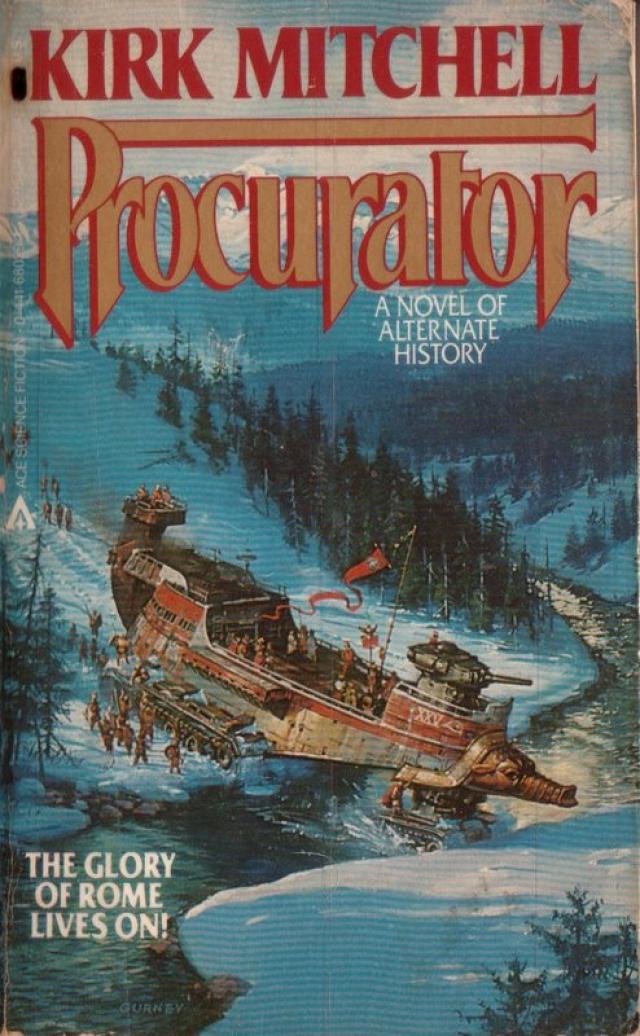
Copyright © 1984 by Kirk Mitchell
Now at the feast the governor was accustomed to release for the crowd any one prisoner whom they wanted. And they had then a notorious prisoner called Barabbas. So when they had gathered, Pilate said to them, “Whom do you want me to release for you, Barabbas or Jesus who is called Christ?” While he was sitting on the judgment seat, his wife sent word to him, “Have nothing to do with that righteous man, for I have suffered much over him today in a dream.”
Now the chief priests and the elders persuaded the people to ask for Barabbas and destroy Jesus. The governor again said to them, “Which of the two do you want me to release to you?” And they said, “Barabbas.” Pilate said to them, “Then what shall I do with Jesus who is called Christ?” They all said, “Let him be crucified.”
Now, with a troubled face, the governor sank into thought. And when Pilate awoke from it, he doubled the guard at the feast and then ordered Jesus to be released. There was a great cry from the crowd against him. But Pilate was adamant.
The governor honored his wife for her dreams.
CHAPTER I
WHEN LAST SEEN alive, the sentry had been pacing up and down the Firat Station platform. The February chill sucked the steam out of his mouth. He looked over his shoulder from time to time, watching for the Bosporus—Parthia rail-galley to slip past in pneumatic silence.
Perhaps he had been dreaming of leaving this place. Duty in the east of Anatolia was not good. All the action was in the Novo Provinces against the newly discovered barbarians. And the girls here were too hobbled by their strange religion to be any fun.
When the rail-galley was gone in a blur of green, red, and white lights, the sentry was found face down on the ice. He was as dead as carrion. But there were no marks on his body.
Within the hour the rumor scampered through the Firat garrison that the soldier had bled to death through the tips of his hair and that his eyeballs had burst in their sockets like overripe pomegranates. Within two hours it was alleged that one of the barbarian zaims, or holy men, had massed against the legionary.
And massing was what the Romans at those snow-blasted outposts along the Great Artery feared most that winter.
As chance would have it, Germanicus Julius Agricola, the military governor of Anatolia, was two hours out from Nova Antiochia when his rail-galley squealed into Firat Station for refueling. This did much for the morale of the men, who thought Germanicus had come on account of the massing. Actually. he was beginning a month-long inspection tour.
Germanicus stepped out onto the platform to stretch his legs and was met by a frantic “Hail, Procurator!” from a large number of soldiers clustered around the station.
Germanicus turned to his adjutant, the Parthian Marcellus. “Colonel, find out what stirs here.”
“Aye, Procurator.”
Then Germanicus began pacing back and forth—just as the now dead legionary had been doing a few hours before. The procurator was a stocky man of fifty years. He had always been solid-looking, and his childhood friends had nicknamed him Taurus, the bull. He had frank hazel eyes that made men immediately wish they had done better for him—even if they had given their best.
Yet for all the authority he exuded, there was wry humor, even a little self-effacing sadness to his mouth.
Colonel Marcellus came racing back from garrison head-quarters, ten steps ahead of his breath, which hung in the air.
“Well?” Germanicus asked.
“A massing. The men think one of the local zaims killed a legionary.”
“What zaim is suspected?”
“The eldest holy man of Firat village,” Marcellus said. “Shall I order his crucifixion?”
“No, wait. Summon my surgeon. Let’s see the body.”
A few minutes later Germanicus. Marcel!us, and the procurator’s Greek physician, Epizelus, were slogging through knee-high snow toward the legionaries’ bath, where the body was being kept until a priest of Isis could arrive from the provincial capital. Yellow steam roiled along the ceiling. The deceased was laid out on a bench beside the soaking pool. One eye was a quarter open.
“Is it a bona fide case?” Germanicus asked in a whisper, because five or six legionaries milling around the place were hanging on every word he said.
The doctor frowned. “Intent cannot be deduced from human tissue, Procurator. Can rape be proved from traces of semen?”
“I’m not a jurist. I asked for an answer—yes or no.”
“Patience, sir.” Epizelus turned to a German centurion who was pouring water on hot stones. “Who is the deceased?”
“He be Gaius Paulus, sir.”
“His age?”
“Twenty-four.”
“Any diseases you know of?”
“Aye, syphilis in Ephesus this summer.”
Epizelus shook his bald head and said to Germanicus, “How many times must I ask you to close down those damned places on the coast?”
“And have rape against the Anatolians increase tenfold?” Germanicus silently watched the doctor prop open the eyes of the dead man, thump his white chest, lift his genitals with frank fingers. “What else can you tell, Epizelus?”
“This is a Roman adult of twenty-four or -five years, approximately one hundred and eighty pounds, six feet,” he answered.
“Is that all? I can see that much for myself.”
“I will need permission for a dissection.”
“You have it.”
“And some privacy in which to work.”
“Everyone out!” Germanicus barked.
“Including you, Procurator,” the doctor said. “Colonel Marcellus may remain to record my observations—with your consent, of course.”
Outside, the winter night stinging his nostrils, Germanicus studied the centurion. Hot mist rose off the man’s uniform. It looked as if he were smoldering under his clothes. “What is your name, centurion?”
“Rolf, sir.”
“A good name. Are you a good soldier?”
“Aye,” he answered gravely.
“Come show me where this happened.” Near the station a group of soldiers stood off by themselves, smoking lungweed. They were veterans, by the looks of them. A raw voice asked. “Procurator, what struck down the lad?”
Germanicus smiled. “Flatulence.”
“Sir?”
“Wind. I will reprimand the cooks.”
Their laughter still had worry in it. But Germanicus knew he had started a counterrumor. How could it be an authentic massing if the procurator himself was joking about it?
A spot of light arced up into the sky and exploded into a shower of sparks. “Flares already tonight?” Germanicus asked.
“Aye, sir,” Rolf said. “All night, every night now—to keep the wrapheads from sneaking up to the Artery. We never know when the next attack be coming.”
Germanicus carried vinegar in his canteen. It was the soldier’s drink of three thousand years of campaigns and occupations. Nothing slaked the thirst like it. He offered some to Rolf, who drained half the vessel.
The German spit most of what he had drunk into the snow. “Not wine. If I be procurator, it would be Gaul wine.”
Germanicus laughed. As supreme commander of Anatolia, he governed three hundred thousand square miles. His jurisdiction incorporated the ancient provinces of Galatia and Cappadocia, plus the defunct kingdom of Armenia. Had the Emperor not abolished the office long ago in the bloody wake of the Proconsular Conspiracy, Germanicus would have been the foremost proconsul in the Empire. But he still had vinegar in his canteen.
“What kind of legionary was this fellow Paulus?” Germanicus asked.
The German shrugged before speaking—which indicated some kind of problem he did not wish to name. “He be all right. Good with both the pilum and the blade.”
“Did he like women?”
“No women here, sir, what be willing.”
“Was it boys. centurion?”
The man said nothing.
Germanicus frowned.
“So that’s what got the zaim after him.”
They bounded up the steps to the platform. In the station light, Germanicus got a better look at the centurion.
Here was a scrapper, to be sure. Well over six feet tall, the German was stoutly built without packing a dram of fat on his ribs. The backs of his ruddy hands were freckled with gold, like salmon skin, and he had full, blond mustaches. The veteran knew just how to stand in the presence of a superior without surrendering an inch of his own calm dignity.
“How long in service, centurion?” Germanicus asked.
“Twenty years, sir.”
“Where have you served the Emperor?”
“First, four years with the guard in Rome.”
“Aye.” Germanicus nodded appreciatively. The centurion looked spit and polish enough to have been with the Emperor’s own.
“Then I transfer to the Sixth Legion.”
“Why?” Germanicus asked.
“To go home to Germania and see my father die. Three years there. Four in campaigns against the new barbarians.”
“How did you find them?”
“The copper bastards be absolute masters of the ambush,” the German said respectfully. “Then three years in Hibernia.”
“My old command with the Third, then?”
“No, after you, sir.”
“Ah, and what did I leave you men?” This was a weather-vane question. Germanicus could sense the man’s instant discomfort. Hibernia was a mess no matter who governed it. This German was too sal
“I was glad to be gone, sir.” Rolf stopped in a circle of light on the platform and took a moment to get his bearings. “This be where I was standing. And Paulus be directly across the Artery from me.” The legionary’s last position was now obscured by the procuratorial rail-galley.
Germanicus looked around as if there might be some material fact dangling in the air like a spider. “How did Paulus seem at supper?”
“No change from usual.”
“Was he irritable?”
“No more than always.” Germanicus leading the way, they passed through the rail-galley to the opposite platform where the legionary had been pacing. There was nothing but a light reddish spot on the ice where the man had fallen. “Did you see Paulus just before the rail-galley came between you?”
“I did.”
“And what was he doing?”
Crow’s-feet sprouted at the outer corners of the centurion’s eyes. “He be looking at the rail-galley, what be coming quick. But all of a sudden he look behind him—like somebody creeping up to surprise him. Then the Bos-Parthian come between us. Next, the rail-galley be gone, and Paulus be dead and down.”
“What did you do?”
“I sound the alarm.”
Colonel Marcellus crossed through the rail-galley with heat in his face. “Procurator!”
“Do you have news?”
“Aye.” the colonel said gravely. In the naked overhead light he was a ramrod-straight figure with a hawkish nose and moist, brooding eyes the color of cork bark. His gloved fingers were like plumes of white feathers—royalty ran through his Parthian ancestry.
“Wait in my quarters.” Germanicus instructed Marcellus, then looked hard at Rolf. “What do you think of this massing business?”
“It just be, sir. Two days before tonight, this zaim went ’bout like a cock, boasting he be ready to kill a Roman without laying a finger on him.”
“What is the talk in the barracks?”
“The men say the zaim did it for sure. No doubt in their mind, Procurator.” The centurion squeezed his brow into fur-rows. “This be my advice—don’t let the zaims get back their old power.”
“I have no intention of allowing that. As for you, get your kit and advise your tribune you’ll be attached to my staff until I say otherwise.”
“Sir, my tribune be a very young officer what don’t know his way about yet.”
“You have your orders, centurion.”
The man jolted to attention.
“Board my rail-galley within the half hour. Dismissed.”
The German trotted down the platform to keep the deadline, his drooping mustaches adding to the impression that he was miserable. Staff duty was no assignment for a man who loved the field. Especially procuratorial duty.
Marcellus rose from the couch when Germanicus entered the car, despite the fact that the procurator muttered. “As you were, as you were.”
“Epizelus has come up with certain findings of interest, sir.”
“Such as?”
“The legionary’s venereal disease was in remission. It was not a factor in his death.”
“That will please his parents. What else?”
“What the man did die from is called an aneurysm.”
“Which is?” Germanicus asked, reclining on his own couch and taking a sip of vinegar from his canteen.
“As best as I can describe it, sir, a section of blood vessel in Paulus’ head ballooned out and exploded.”
“Charicles, bring the colonel some wine,” Germanicus called to his aged manservant. “Odd way for a young fellow to die, what, Marcellus? Did you mention massing again for me?”
“I did. The doctor knows of no such thing in medical science. He asks that you refer such ‘ethereal questions’ to Colonel Crispa.”
There was silence between the men at the mention of the woman.
Charicles padded down the aisle from the smoky mess, the tip of his tongue protruding from the corner of his mouth as he balanced a wine serving set on a tray. “Good evening to you, gentlemen.” He smiled as if he had made a jest. But it was not his own remark that amused him. It was Marcellus’ reference to Crispa.
The old man had been listening to Marcellus and Germanicus for some minutes. He was certain that he alone knew that both these officers loved the pale, blonde Scandian beauty. And no wonder: for all her high rank, she was a sensual girl with alluring, nearly haunted eyes—aquamarine in color. “Will there be anything else, Procurator?”
“Nothing for me. We’ll be taking a centurion on with us. See that he has a place to bunk.”
“Would this be the German?” Charicles asked with distaste.
Germanicus patted the stooped back of the servant. “Suffer change cheerfully, old friend. It’s the only way I know to have peace of mind.”
“But a German, sir.”
Marcellus emptied his cup in a single draught. “Well, I must be off to check on the refueling. Any further orders, sir?”
“Yes, find out where the hades Crispa is.”
“At once, Procurator.”
Alone, Germanicus unhitched his breastplate and laid it aside. He had felt foolish with Marcellus. It angered him that his feelings for Crispa showed, although they had been transparent ever since she had appeared at his headquarters in Hibernia, a thin tribune with eyes too large for her face, much too knowing for her years. She had seemed to him the beautiful daughter of another world, arrived in the Empire only to be unblinkingly fascinated by all around her.
But the procurator had never set the wheels of his affection into motion. He had a keen sense of how, once started, the momentum of these passions could not be slowed.
And he had a wife in Ostia. Her health was delicate. He would not buy his pleasure at the price of her pain.
Two more months and he would be back home, retired. This would be for the better. He would let the days trickle away as he sat at the point of the headland, under the olive tree whose leaves in winter were scorched by the salt spray. It was here his son’s ashes were hidden. He had lied to his wife, Virgilia, saying that the young tribune’s ashes had been sprinkled over the Tiber at its outlet. This was so she would have no spot on which to focus her grief.
But as his time of service became shorter, his resolve to leave Crispa untouched became as taut as a bowstring pulled to its limit. Not that he lacked willpower. When it was brought to his attention that he was spending too many of his free evenings in his cups, he quit wine and never again touched anything stronger than vinegar. Furthermore, when Epizelus told him that continued smoking of lungweed might do away with the need for a pension, Germanicus took the clay pipe from his mouth and smashed it.
It was almost as if he enjoyed parting from things he desired.
His fidelity had become a comic legend, the legionaries under his command had composed a ballad in which Germanicus, upon finding both Helen and Cleopatra nude in his chamber—“a brace of lovelies,” as it went—severely warned both that there’d be no wrestling in his bed.
All would have been simpler had Crispa not told him how she felt about him. It had happened during the Hibernian civil war. Germanicus was ordering an inspection of a garrison on the west coast of the island when a troubled look crossed Crispa’s face. This tribune was ordinarily so dutiful and eager to please, Germanicus stopped talking, then asked, “What is it?”
“Do—do not go, sir.”
“What?”
“Not today,” she said, her eyes now moist with embarrassment.
Germanicus smiled so the others would not become infected with whatever was upsetting her. People who must endure invisible dangers day after day become as superstitious as shepherds. “Come, tribune.” he said cheerfully, “you ride in my sand-galley.” As he had led the way down the marble steps of his headquarters, a momentary illusion had startled him: the sun had a drop of blood in it.
Charicles knocked on the bulkhead with his brittle knuckles. “Procurator!”
Germanicus was jarred from his memories. “Yes!” His heart was already racing because of the edge on the old man’s voice.
“Marcellus sees fire to the north!”
“Where is he?”
“On your ballistae defense deck.”
Germanicus rushed down the aisle, then drummed up the metal stairs to the platform on the rear of his car. Marcellus was staring off over the snow-blanketed roof of the station.